Wind Turbine Tree as an Innovative Solution for Urban Renewable Energy Development
2026-08-19 16:51:23 by Scientific Writer
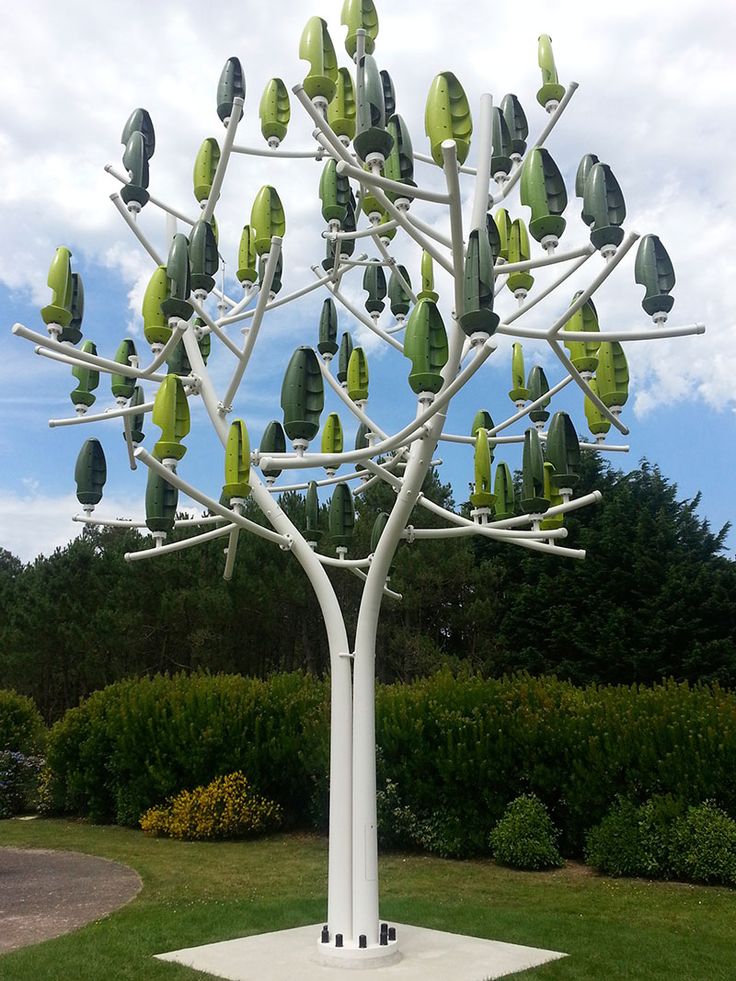
The increasing global demand for energy and the growing environmental impacts caused by fossil fuel consumption have accelerated the development of renewable energy technologies. Wind energy has emerged as one of the promising renewable energy sources due to its sustainability and low carbon emissions. Among recent innovations in wind energy technology, the Wind Turbine Tree has attracted considerable attention. Its popularity stems from integrating renewable energy generation with aesthetic urban design.
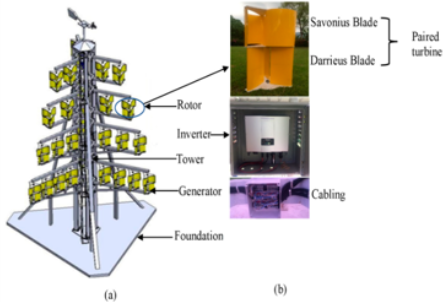
Figure 1. Wind turbine tree (a) and turbine structure (b)[1]
Wind Turbine Tree is a vertical-axis wind turbine (VAWT) system inspired by the structure of a tree. Unlike conventional horizontal-axis wind turbines, this technology consists of multiple small Savonius-type turbines installed on branch-like structures [1]. These turbines are designed to capture wind from various directions simultaneously, making them suitable for urban environments where wind patterns are often turbulent and inconsistent [2]. Each turbine is connected to a generator that converts mechanical rotational energy into electrical energy.
One of the primary advantages of Wind Turbine Tree technology is its architectural and aesthetic integration into urban landscapes. Conventional wind turbines are often criticized for their large dimensions and visual impact, whereas Wind Turbine Trees are designed to blend with city environments and public spaces. This innovative design allows installation in parks, pedestrian areas, commercial centers, and smart city infrastructure while simultaneously enhancing urban aesthetics. Furthermore, the compact structure reduces land-use requirements compared to large-scale wind farms.
Despite these advantages, several technical challenges remain significant. The first challenge concerns energy efficiency. Small-scale turbines generally produce lower power output compared to large conventional turbines due to limited rotor size and reduced aerodynamic performance [3]. As a result, the overall electrical generation capacity of Wind Turbine Tree systems remains relatively low. Wind turbulence in urban environments may also reduce the consistency of turbine rotation and energy conversion efficiency.
Another important issue is power management and system integration. Since Wind Turbine Trees contain numerous small turbines operating simultaneously, managing fluctuating electrical output becomes technically complex [4]. Efficient control systems and advanced power electronics are required to regulate voltage stability, energy storage, and grid synchronization [5]. Without proper management systems, energy losses and operational instability may occur.
Nevertheless, Wind Turbine Tree technology demonstrates substantial potential for future renewable energy development, particularly in urban areas. Ongoing advancements in aerodynamics, smart control systems, lightweight materials, and energy storage technologies may significantly improve performance and economic feasibility. Although several limitations remain, continuous research and technological development are expected to enhance the practicality and effectiveness of Wind Turbine Tree systems as part of future smart and sustainable cities. Furthermore, broader implementation through pilot projects and long-term performance evaluation will provide valuable insights to support the large-scale adoption of Wind Turbine Tree technology in sustainable urban energy systems.
References
[1] D. M. Ngoc, M. Luengchavanon, P. T. Anh, K. Humphreys, and K. Techato, “Shades of Green: Life Cycle Assessment of a Novel Small-Scale Vertical Axis Wind Turbine Tree,” Energies, vol. 15, no. 20, 2022, doi: 10.3390/en15207530.
[2] A. Mostafaeipour, M. Rezaei, M. Jahangiri, and M. Qolipour, “Feasibility analysis of a new tree-shaped wind turbine for urban application: A case study,” Energy Environ., vol. 31, no. 7, pp. 1230–1256, 2020, doi: 10.1177/0958305X19888878.
[3] A. Rosato, A. Perrotta, and L. Maffei, “Commercial Small-Scale Horizontal and Vertical Wind Turbines: A Comprehensive Review of Geometry, Materials, Costs and Performance,” Energies, vol. 17, no. 13, pp. 1–43, 2024, doi: 10.3390/en17133125.
[4] S. Li et al., “Experimental investigation on noise characteristics of small scale vertical axis wind turbines in urban environments,” Renew. Energy, vol. 200, no. July, pp. 970–982, 2022, doi: 10.1016/j.renene.2022.09.099.
[5] M. K. Rathore, M. Agrawal, P. Baredar, A. K. Shukla, G. Dwivedi, and P. Verma, “Fabrication and Performance Analysis of the Aero-Leaf Savonius Wind Turbine Tree,” Energies, vol. 16, no. 7, 2023, doi: 10.3390/en16073015.
Author, Intan Dwi Cahyani
Recent Posts

From Peel to Power: Optimizing DSSCs with Betacyanin Extract
2026-08-24 20:19:00