From Peel to Power: Optimizing DSSCs with Betacyanin Extract
2026-08-24 20:19:00 by Scientific Writer
As global electricity demand rises, coal remains a dominant energy source contributing significantly to carbon emissions and climate change, driving researchers toward sustainable alternatives such as Dye-Sensitized Solar Cells (DSSC). Among the natural sensitizers explored, betacyanin extracted from beetroot has emerged as one of the most promising options because it is simple to prepare, widely available, and low in cost. Studies pairing beetroot-derived betacyanin with a WO3-coated TiO2 photoanode have reported conversion efficiencies as high as 2.2%, with a photovoltage of 435 mV and photocurrent of 9.86 mA, making betacyanin one of the more effective pigment components identified so far for natural-dye DSSCs [1]. This performance raises a deeper question: what gives betacyanin its advantage over other plant pigments at the molecular level?
Betacyanin belongs to the betalain family of pigments, alongside the yellow-orange betaxanthins, and its light-harvesting behavior depends heavily on how the extract is processed. Time-Dependent Density Functional Theory calculations (TD-DFT) of betalain pigments show how their electronic spectra align with the solar spectrum, and experiments varying extraction solvent, pH, and extract composition help optimize DSSC fabrication using these pigments. Lowering the pH of the dye solution increases the ratio of betacyanins relative to betaxanthins, likely through hydrolysis of betanin to betanidin, and this shift improves device performance because betacyanins overlap more favorably with the solar spectrum than betaxanthins do. Purifying the extract further raises efficiency compared with using raw, unprocessed extracts [2]. These molecular-level findings translate directly into the wide range of efficiencies reported across different betacyanin-rich plant sources.
Performance varies considerably depending on which plant source supplies the betacyanin. Red turnip extract sensitized with TiO2 has achieved an overall efficiency of 1.7% under AM 1.5 irradiation, supported by a current density of 9.5 mA/cm² and an incident photon-to-current efficiency of 65% at 470 nm, outperforming extracts from wild Sicilian prickly pear and bougainvillea flowers tested under the same conditions [3]. Bougainvillea bract extracts, by contrast, have yielded a more modest efficiency around 0.48%, though researchers found that a mixture of betaxanthin and betacyanin outperforms betacyanin alone, since the two pigments absorb photons at different wavelengths and together capture a broader portion of the spectrum [5]. Beetroot extract stabilized with tetraethylorthosilicate (TEOS) has reached about 0.89% efficiency while also resisting UV-induced degradation far better than untreated extract, addressing one of the most persistent weaknesses of natural-dye DSSCs: pigment instability over time [4]. These source-dependent results suggest that combining pigments deliberately, rather than relying on a single extract, may be the more reliable path to higher efficiency.
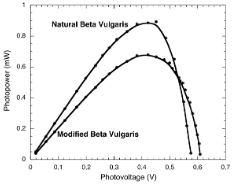
Fig 1. Power-photovoltage curves for BVE and BVE/TEOS solar cells [4]
The benefits of combining complementary pigments can also be observed through co-sensitization strategies. Combining a red dye extracted from red spinach with a green dye from Malabar spinach at an optimized 80:20 ratio produced a cell efficiency of 0.847% [6]. This improvement occurs because the combined pigments absorb light across a wider range of wavelengths than individual pigments [6]. This pattern is consistent with the betaxanthin betacyanin mixture and suggests that pairing complementary pigments can improve natural dye DSSC performance.
Betacyanin based DSSCs still trail synthetic ruthenium dyes in raw efficiency, but their low cost, biodegradability, and potential use of agricultural waste make them an attractive option for accessible solar technology. Future progress will likely depend on refining extraction pH and purification methods, pairing betacyanin with complementary pigments, and improving photoanode materials and stabilizing treatments to extend device lifetime. These findings reveal a research gap in optimizing different natural dye extracts and their combinations for DSSCs. Further research on variations in dye extracts and their mixing ratios could provide new approaches to improve light absorption and overall cell efficiency.
References
[1] M. Tripathi, R. Upadhyay, and A. Pandey, “Novel dye based photoelectrode for improvement of solar cell conversion efficiency,” Applied Solar Energy, vol. 49, no. 1, pp. 54–57, 2013, doi: 10.3103/S0003701X13010131.
[2] A. Dumbrava, I. Enache, C. I. Oprea, A. Georgescu, and M. A. Girtu, “Toward a more efficient utilisation of betalains as pigments for dye-sensitized solar cells,” Digest Journal of Nanomaterials and Biostructures, vol. 7, no. 1, pp. 339–351, 2012.
[3] G. Calogero, G. Di Marco, S. Cazzanti, S. Caramori, R. Argazzi, A. Di Carlo, and C. A. Bignozzi, “Efficient dye-sensitized solar cells using red turnip and purple wild Sicilian prickly pear fruits,” International Journal of Molecular Sciences, vol. 11, no. 1, pp. 254–267, 2010, doi: 10.3390/ijms11010254.
[4] A. R. Hernández-Martínez, M. Estévez, S. Vargas, and R. Rodríguez, “Stabilized conversion efficiency and dye-sensitized solar cells from Beta vulgaris pigment,” International Journal of Molecular Sciences, vol. 14, no. 2, pp. 4081–4093, 2013, doi: 10.3390/ijms14024081.
[5] A. R. Hernandez-Martinez, M. Estevez, S. Vargas, F. Quintanilla, and R. Rodriguez, “New dye-sensitized solar cells obtained from extracted bracts of Bougainvillea glabra and spectabilis betalain pigments by different purification processes,” International Journal of Molecular Sciences, vol. 12, no. 9, pp. 5565–5576, 2011, doi: 10.3390/ijms12095565.
[6] F. Kabir, M. M. H. Bhuiyan, M. R. Hossain, H. Bashar, M. S. Rahaman, M. S. Manir, S. M. Ullah, S. S. Uddin, M. Z. I. Mollah, R. A. Khan, and S. Huque, “Improvement of efficiency of dye sensitized solar cells by optimizing the combination ratio of natural red and yellow dyes,” Optik, vol. 179, pp. 252–258, 2019, doi: 10.1016/j.ijleo.2018.10.150.
Author: Muhammad Rangga Adiputra Candra & Ayu Salsabila Syifania
Recent Posts
From Peel to Power: Optimizing DSSCs with Betacyanin Extract
2026-08-24 20:19:00