Subsurface Reservoir Development in Enhanced Geothermal Systems for Sustainable Power Generation
2026-08-24 20:05:24 by Scientific Writer
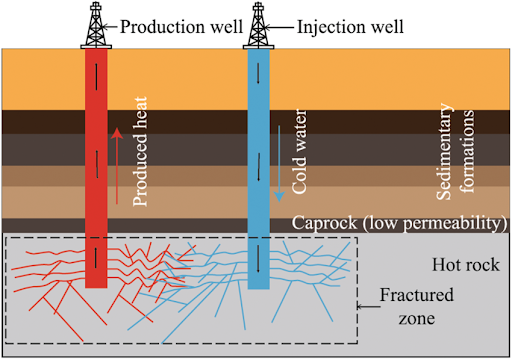
Global energy transitions increasingly require reliable low carbon resources that can complement intermittent solar and wind generation across electricity systems. Geothermal energy provides continuous power by extracting thermal energy stored within subsurface formations and converting heat into useful electrical output [5]. However, conventional geothermal development depends strongly on naturally permeable reservoirs containing sufficient heat, fluid, and interconnected geological pathways available within [1]. These geological requirements restrict deployment because suitable hydrothermal reservoirs occur unevenly beneath Earth's surface and remain difficult to characterize accurately. Enhanced Geothermal Systems offer an alternative approach by developing subsurface permeability within hot formations that lack adequate natural reservoir conditions.
Enhanced Geothermal System (EGS) expands geothermal development by deliberately establishing fluid circulation pathways through hot rocks using innovative advanced engineered subsurface stimulation techniques. Unlike conventional systems, EGS can target hot formations where natural permeability remains insufficient for technically reliable economically sustainable geothermal production. The fundamental objective involves transferring heat from deep rock formations into circulating fluids and delivering thermal energy toward production wells [7]. Geoscientists and reservoir specialists characterize temperature, stress, mineralogy, permeability, and fracture networks before designing suitable wells and specific stimulation strategies for individual reservoirs. This multidisciplinary assessment determines whether subsurface conditions can support stable circulation, efficient heat transfer, and sustainable long term energy recovery.
In this process, geological and geophysical investigations that identify prospective formations containing elevated temperatures at economically accessible depths underground. Exploration teams combine seismic surveys, well logging, temperature measurements, geological mapping, and geochemical analysis to characterize subsurface conditions more comprehensively [2]. Developers then construct injection and production wells that connect surface facilities with targeted hot rock formations beneath the ground directly. Injection wells deliver working fluids into the stimulated reservoir, while production wells recover heated fluids after efficient subsurface thermal exchange. Operators continuously evaluate reservoir responses because fluid pressure, temperature, permeability, and seismicity can change during sustained geothermal circulation continuously safely.
Hydraulic stimulation represents a critical EGS process because operators increase effective permeability and establish interconnected pathways through relatively hot rocks [8]. Controlled fluid injection modifies existing fractures and can create additional conductive pathways that improve fluid access throughout the heated reservoir. However, stimulation requires careful pressure management because excessive fluid pressure may activate geological faults and generate induced seismicity microearthquake events. Microseismic monitoring therefore helps operators identify fracture development, evaluate reservoir connectivity, and maintain stimulation within acceptable operational boundaries effectively safely. Successful stimulation balances permeability enhancement with reservoir integrity, enabling efficient heat extraction while minimizing associated unwanted geological and environmental consequences.
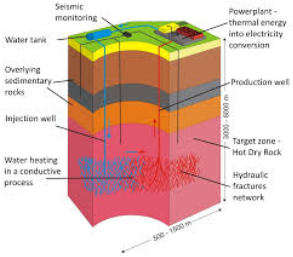
Fig 1. EGS hydraulic stimulation and fracture network [7]
Indonesia possesses substantial geothermal resources because its tectonic setting creates extensive volcanic and magmatic systems across several major geological regions. However, conventional geothermal development still encounters exploration uncertainty, difficult terrain, high drilling costs, and highly complex subsurface reservoir conditions underground [9]. Enhanced Geothermal Systems could complement existing geothermal strategies by potentially utilizing hot formations where natural permeability or fluid availability limits conventional production. Researchers must nevertheless evaluate Indonesian local geological conditions because successful EGS deployment depends on rock properties, stress regimes, and hydrology. Strategic development could combine advanced drilling, reservoir stimulation, monitoring technologies, and integrated power systems to strengthen Indonesia's renewable energy.
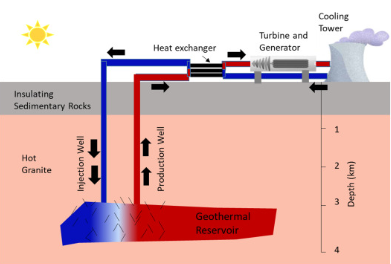
Fig 2. EGS geothermal power generation schematic [6]
Future EGS development will increasingly integrate advanced drilling, numerical reservoir simulation, fiber optic sensing, artificial intelligence, and real time monitoring. These technologies can improve subsurface characterization, optimize stimulation strategies, predict reservoir behavior, and support more reliable operational decision making processes. Closed loop geothermal concepts may further reduce dependence on natural fluid circulation by transferring heat through sealed subsurface systems efficiently. Superhot geothermal research also investigates extremely high temperature resources that could potentially deliver energy density and improve power generation efficiency. Together, these innovations position EGS as an important pathway for transforming deeper geothermal heat into reliable low carbon electricity globally.
References
[1] G. Ifrene, K. Kuldeep, and W. Gosnold, “Advancements, challenges, and outlook of geothermal reservoir operations,” in Geophysical Exploration for Hydrocarbon Reservoirs, Geothermal Energy, and Carbon Storage: New Technologies and AI-Based Approaches, pp. 379–416, 2025.
[2] G. Shabir, “Subsurface characterization through well-log analysis: A comprehensive approach to reservoir evaluation and hydrocarbon assessment,” Journal of Petroleum Geoscience and Engineering, vol. 78, pp. 112–130, 2023.
[3] M. Khodayar and S. Björnsson, “Conventional geothermal systems and unconventional geothermal developments: An overview,” Open Journal of Geology, vol. 14, no. 2, pp. 196–246, 2024.
[4] M. Ngoma, O. Kolawole, and O. Olorode, “Geothermo-mechanical alterations due to heat energy extraction in enhanced geothermal systems: Overview and prospective directions,” Deep Underground Science and Engineering, vol. 3, pp. 256–268, 2024, doi: 10.1002/dug2.12109.
[5] M. Shah, M. Prajapati, K. Yadav, and A. Sircar, “A comprehensive review of geothermal energy storage: Methods and applications,” Journal of Energy Storage, vol. 98, Art. no. 113019, 2024.
[6] P. A. Fokaides, A. Kylili, and P.-Z. Georgali, Environmental Assessment of Renewable Energy Conversion Technologies. Elsevier, 2022, ISBN: 978-0-12-817111-0, doi: 10.1016/C2018-0-02028-9.
[7] R. Moska, K. Labus, and P. Kasza, “Hydraulic fracturing in enhanced geothermal systems—Field, tectonic and rock mechanics conditions—A review,” Energies, vol. 14, no. 18, Art. no. 5725, 2021, doi: 10.3390/en14185725.
[8] Y. Jia, C. F. Tsang, A. Hammar, and A. Niemi, “Hydraulic stimulation strategies in enhanced geothermal systems (EGS): A review,” Geomechanics and Geophysics for Geo-Energy and Geo-Resources, vol. 8, no. 6, Art. no. 211, 2022.
[9] Y. Liu, K. Li, Z. Guan, G. Lin, and Y. Xu, “Research on circulating heat recovery law of single horizontal well for hot dry rock geothermal resources,” Renewable Energy, vol. 217, Art. no. 119108, 2023.
Author, Rahmania Putri Ramadhani
Recent Posts

From Peel to Power: Optimizing DSSCs with Betacyanin Extract
2026-08-24 20:19:00
