Using Artificial Intelligence in Mechanical Design
2026-05-06 05:51:13 by Scientific Writer

Artificial Intelligence (AI) now transforms mechanical design by enabling engineers to explore more solutions in less time. AI-driven tools generate and evaluate multiple design candidates simultaneously, cutting development cost and iteration cycles significantly. Research confirms that these capabilities mark a fundamental shift in how engineering teams develop and validate mechanical systems [1]. Engineers who adopt AI early in their workflows gain a measurable competitive edge over traditional development approaches. This shift begins most visibly at the concept selection stage.
During early-stage design, AI brings empirical statistics directly into the development process before engineers commit resources to prototyping. Teams can select the best configuration from a range of optimal conceptual designs with greater confidence and speed. In aerospace engineering, AI methods improve structural concept development and reduce evaluation time for competing configurations [2]. Explainable AI further strengthens this process by helping engineers understand why an algorithm favors certain candidates over others [3]. Such transparency prepares teams to integrate AI outputs into simulation environments with greater accuracy.
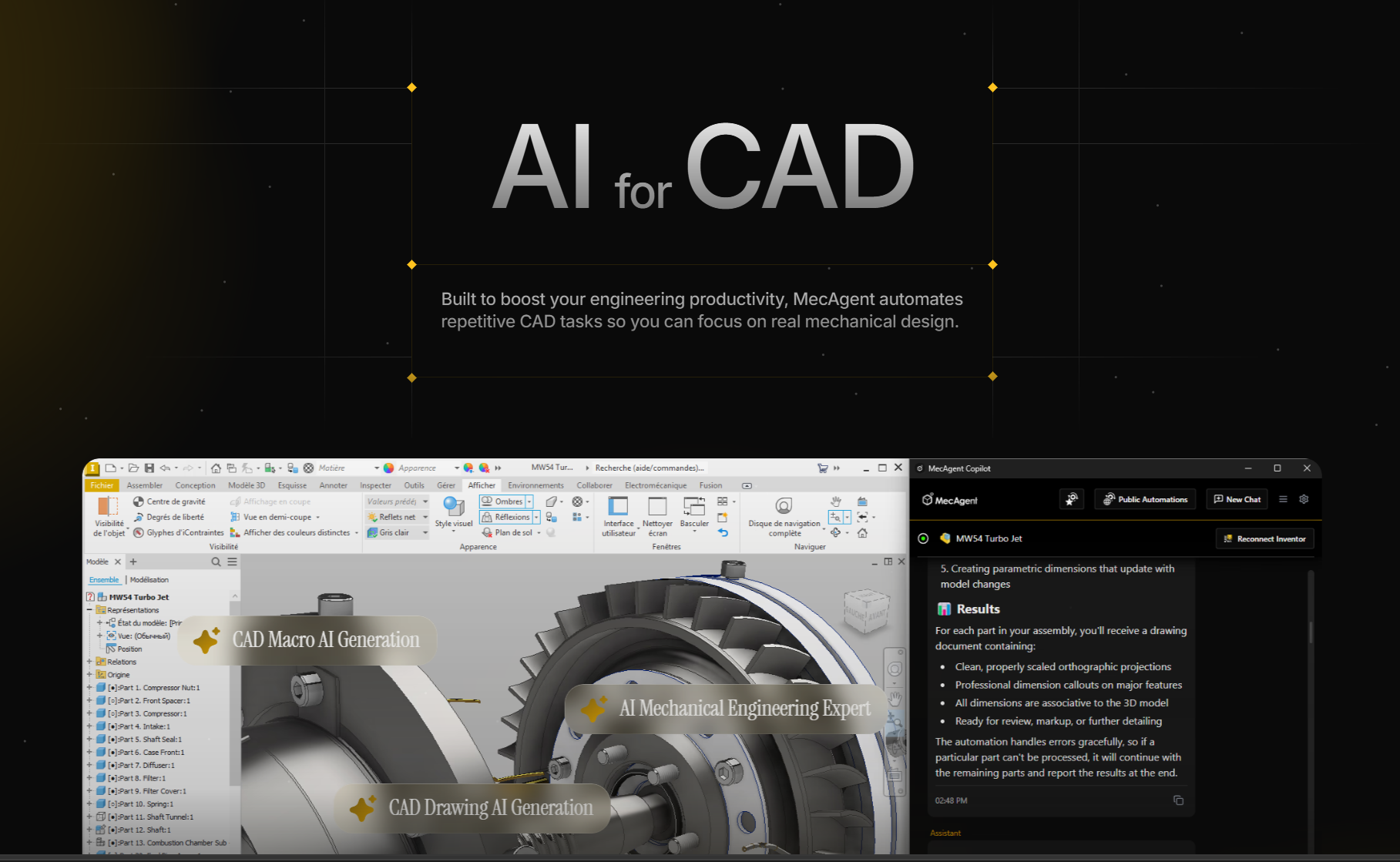
Source: https://mecagent.com/
Digital twins and machine learning now form a powerful combination for simulating large-scale and complex mechanical systems. Multi-level model integration allows engineers to study system behavior across different scales before physical testing begins [4]. Machine learning-driven frameworks also apply digital twin technology to energy efficiency analysis, identifying performance improvements without costly experiments [5]. These virtual models reduce trial-and-error across the entire development cycle. Topology optimization builds on this foundation by further refining component-level performance decisions.
Topology optimization continues to attract significant research attention, particularly in thermal management and satellite network design. Engineers apply this method to remove unnecessary material while preserving performance targets under complex operational constraints. In semiconductor packaging, topology optimization addresses embedded cooling challenges across multiple transient workload conditions [6]. Satellite constellation designers also use this approach to improve communication coverage while minimizing resource requirements in low Earth orbit systems [7]. These domain-specific applications demonstrate how optimization techniques continue to expand across engineering disciplines.
Successful AI adoption in mechanical design requires organizations to address data quality, model interpretability, and manufacturing feasibility together. AI-generated geometries sometimes exceed current fabrication capabilities, requiring engineers to apply post-processing constraints before production begins [6]. Companies that invest in curated datasets and cross-disciplinary training programs accelerate adoption across their design teams [1]. Engineers advance the profession most effectively when they treat AI as a collaborative partner that augments, rather than replaces, domain expertise.
Reference
[1] Tiwari, N. S. Gaira, R. Tiwari, A. S. Singh, A. K. Yadav, and S. Khanduri, “AI-Driven Design of Composite Materials for Aerospace Engineering,” in 2024 Second International Conference Computational and Characterization Techniques in Engineering & Sciences (IC3TES), 2024, doi: 10.1109/IC3TES62412.2024.10877546.
[2] “Scientific Machine Learning Enables Digital Twins for Large-Scale Complex Systems,” in 2024 IEEE Conference paper, 2024.
[3] “Explainable AI Assisted Evolutionary Search of Engineering Designs,” in 2024 IEEE 36th International Conference on Tools with Artificial Intelligence (ICTAI), 2024.
[4] B. Picano, M. Becattini, et al., “Democratized Learning Enabling Multi-Level Digital Twin Model Integration,” in IEEE Transactions on Vehicular Technology, 2024.
[5] “Machine Learning Driven Energy Efficiency Framework Using Digital Twin: A Review,” in 2024 IEEE Conference paper, 2024.
[6] Z. Wu, A. R. Kidambi, Y. T. Yang, C. M. Hung, S. Tian, and X. Zhang, “Topology Optimization for Embedded Cooling of Multiple and Transient Workloads in 3D Semiconductor Packages,” in 2025 24th IEEE Intersociety Conference on Thermal and Thermomechanical Phenomena in Electronic Systems, 2025.
[7] D. Ron et al., “Time-Dependent Network Topology Optimization for LEO Satellite Constellations,” in 2025 IEEE paper, 2025.
Author, Ridhoillah Rachmansyah
Recent Posts

From Peel to Power: Optimizing DSSCs with Betacyanin Extract
2026-08-24 20:19:00