Smart Farming Through Agrivoltaic Technology
2026-08-19 15:55:19 by Scientific Writer
Agrivoltaic systems (APV) combine solar energy production with crop cultivation on a single land area. These systems offer a dual-use solution to resolve land-use conflicts between the energy and agricultural sectors [1]. Photovoltaic panels significantly reduce solar irradiation and create microclimates that affect evapotranspiration, soil temperature, and photosynthetic rates [2]. And then the 30% role distribution for energy and 70% for rice production in APV systems is illustrated with figure 1.
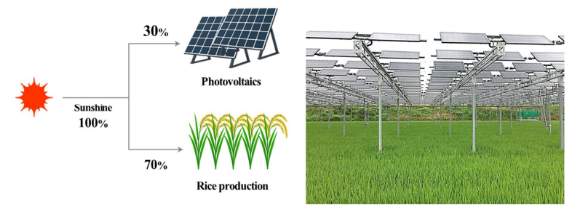
Fig 1. Dual-use concept of agrivoltaic system showing 30% solar radiation for photovoltaics and 70% for rice production [3]
Engineers must carefully consider panel height, inter-row spacing, and tilt angles when designing APV systems. Bifacial and semi-transparent solar panels now serve as key innovations for system optimization across different countries [1]. Proper configuration maximizes light distribution while maintaining optimal crop productivity. Several nations have implemented regulations limiting crop yield reductions caused by APV shading, such as Japan 20% and Germany 33% limits [4]. Understanding these regulations requires examining how different shading levels impact crop performance.
Shading intensity determines the physiological responses and yields of various agricultural commodities. Research shows that rice plants maintain stable yields under 27% shading levels [4]. In contrast, soybean experiences yield reductions reaching 30% at 33% shading intensity [5]. Sweet potato shows more drastic yield reductions up to 40% at 31% shading [4]. Plants respond to shading conditions by increasing stem height and altering shoot-to-root ratios.
APV systems enhance land-use efficiency through simultaneous energy and food production. This finding is relevant to the research reported by Omer., (2025) which demonstrated that agrivoltaic systems increased water-use efficiency (WUE) by 20–47% and reduced air and soil temperatures by 1–4°C beneath APV panels [2]. Reduced evapotranspiration rates support water conservation, especially in arid and semi-arid regions [6]. Optimizing APV designs requires careful balance between energy production and agricultural yields. Despite these clear advantages, the high upfront cost of installing APV systems prevents widespread adoption.
High initial investment costs represent the main barrier to APV system adoption across countries. Research remains limited to temperate regions, with few studies conducted in tropical climates like Southeast Asia [6]. Selecting shade-tolerant crop varieties critically determines the success of APV systems. Pre-installation modeling helps accurately predict energy performance and crop yields. Collaboration between energy and agricultural researchers proves essential for developing integrated standards.
Agrivoltaic systems face real trade-offs between energy yield and corp productivity. Studies report yield reduction of 9-18% under moderate shading, but many farmers still find this penalty acceptable [3]. High installation costs block widespread adoption, especially in developing countries [6]. Future research needs to focus more on shade-tolerant crop varieties and cheaper panel design. Without improvement, PAV systems will struggle to compete with conventional farming and solar farms.
Reference
[1] A. Sarr, Y. M. Soro, A. K. Tossa, and L. Diop, "Agrivoltaic, a synergistic co-location of agricultural and energy production in perpetual mutation: A comprehensive review," Processes, vol. 11, no. 3, p. 948, Mar. 2023.
[2] A. A. A. Omer, M. Li, F. Zhang, M. M. E. Hassaan, W. M. F. F. El-kolaly, X. Zhang, H. Lan, J. Liu, and W. Liu, "Impacts of agrivoltaic systems on microclimate, water use efficiency, and crop yield: A systematic review," Renewable and Sustainable Energy Reviews, Jun. 2025.
[3] S.-M. Yun, D.-G. Seong, J. J. Lee, and J.-S. Chung, "Assessment of rice productivity and solar power generation in agriphotovoltaic systems," Agriculture, vol. 15, no. 15, p. 1741, Aug. 2025.
[4] N. Maruyama, M. Nozawa, H. Tomioka, K. Tachibana, T. Magami, H. Kurasaka, M. Akimoto, and Y. Fukano, "On-farm agrivoltaic impacts on main crop yield: the roles of shade avoidance, cultivation practices, and varieties," npj Sustainable Agriculture, vol. 4, p. 12, Feb. 2026.
[5] S. Zainali, S. M. Lu, Á. Fernández-Solas, A. Cruz-Escabias, E. F. Fernández, T. E. K. Zidane, E. H. Honningdalsnes, M. M. Nygård, J. Leloux, M. Berwind, M. Trommsdorff, S. Amaducci, S. Gorjian, and P. E. Campana, "Modelling, simulation, and optimisation of agrivoltaic systems: a comprehensive review," Applied Energy, vol. 386, p. 125558, May 2025.
[6] S. I. Abubakar, C. H. See, F. M. Sukki, R. Mahendiran, S. Sundaram, and M. I. Z. Abidin, "Deploying Agrivoltaics in Sub-Saharan Africa—A sustainable pathway toward energy-food security-challenges and opportunities: A review," IEEE Xplore, Apr 2025.
Author, Nafisatul Laili Farikha
Recent Posts
From Peel to Power: Optimizing DSSCs with Betacyanin Extract
2026-08-24 20:19:00