Development of ZnO/GQDs Nanocomposite-Based DSSC with Betacyanin Sensitizer from Dragon Fruit (Hylocereus polyrhizus) Peel Waste for Photoconversion Optimization
2026-04-02 19:27:53 by Scientific Writer
Penulis : Moch. Dava Septiadi Pratama_Scientific Writer
22 February 2026
Global electricity demand continues to increase, while coal remains a dominant conventional fuel source. In 2023, coal supplied 35.51% of electricity production and emitted 15 billion tons of CO? annually [1]. These emissions significantly contribute to climate change and environmental degradation. Researchers therefore seek green technologies to convert renewable energy into electricity efficiently. Dye-Sensitized Solar Cells (DSSC) offer a promising alternative for sustainable energy generation [2].
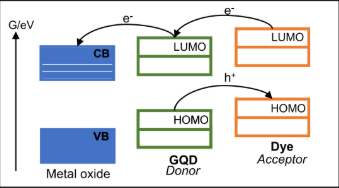
Figure 1. Type-II alignment of GQDs and dye in DSSC [3].
DSSC operates by using dye molecules to capture photons and inject electrons into a semiconductor photoanode. Manufacturers can produce DSSC at lower costs than silicon, CZTS, and perovskite solar cells [4]. DSSC also allows flexible design and low-temperature fabrication processes. However, natural sensitizers absorb light within a narrow spectral range. High electron recombination further limits the overall photoconversion efficiency [1].
Researchers propose ZnO/GQDs nanocomposites to enhance optical response and charge transport. ZnO provides high electron mobility and suitable bandgap energy for DSSC applications [4]. Graphene quantum dots (GQDs) offer large surface area and strong quantum confinement effects [3]. Scientist reported Jsc of 19.74 mA·cm?², Voc of 0.957 V, and PCE of 13.4% after GQDs integration [5]. These results indicate reduced recombination and enhanced light absorption.
Dragon fruit peel waste (Hylocereus polyrhizus) contains high concentrations of betacyanin pigment. Betacyanin absorbs strongly at 530–540 nm within the visible spectrum [2]. Indonesia generates approximately 35.83 tons of dragon fruit peel waste annually [6]. Previous studies reported Jsc of 2.42 mA/cm² and Voc of 0.44 V using betacyanin [7]. These findings demonstrate its potential as a natural sensitizer.
The integration of betacyanin with ZnO/GQDs may also enhance electron transfer from dye to semiconductor. Functional groups in betacyanin can bind strongly to ZnO/GQDs surfaces [8]. Strong adsorption improves light harvesting efficiency and interfacial charge transport. Co-sensitization strategies have demonstrated improved efficiency compared to single dye systems [2]. Therefore, this approach promotes sustainable biomass utilization while enhancing DSSC photoconversion performance.
References
[1] A. Saletnik, B. Saletnik, and C. Puchalski, “Coal as the world’s dominant energy source and its role in the energy transformation and regulations of European Green Deal,” J. Environ. Manage., vol. 392, p. 126815, 2025, doi: 10.1016/j.jenvman.2025.126815.
[2] F. Nurosyid, U. Riyadi, H. Widiyandari, Y. Iriani, Khairuddin Khairuddin, and R. Suryana, “Optoelectronic Properties of Combinations of Anthocyanin, Betalain, and Chlorophyll doped with Ag Metal as the Photosensitizers in Dye-Sensitized Solar Cell,” Evergreen, vol. 11, no. 3, pp. 2135–2141, 2024, doi: 10.5109/7236857.
[3] S. Mahalingam et al., “Mixture deposition method for graphene quantum dots-based dye-sensitized solar cell,” Electrochimica Acta, vol. 404, p. 139732, 2022, doi: 10.1016/j.electacta.2021.139732.
[4] R. Vittal and K.-C. Ho, “Zinc oxide based dye-sensitized solar cells: A review,” Renew. Sustain. Energy Rev., vol. 70, pp. 920–935, 2017, doi: 10.1016/j.rser.2016.11.273.
[5] D. Zhao, R. M. Saputra, P. Song, Y. Yang, and Y. Li, “How graphene strengthened molecular photoelectric performance of solar cells: A photo current-voltage assessment,” Sol. Energy, vol. 213, pp. 271–283, Jan. 2021, doi: 10.1016/j.solener.2020.11.034.
[6] A. Brunerová, U. Hasanudin, D. A. Iryani, and D. Herák, “Analysis of Tropical Fruit Waste Biomass Generation in Indonesia and Its Reuse Potential:,” presented at the International Conference on Sustainable Biomass (ICSB 2019), Bandar Lampung, Indonesia, 2021. doi: 10.2991/aer.k.210603.027.
[7] R. Pratiwi, R. D. Mulyaningsih, and A. N. Hasanah, “Development of paper based colorimetric method using pigment from red dragon fruit for determination of Cu and Fe,” Sci. Rep., vol. 15, no. 1, p. 13522, 2025, doi: 10.1038/s41598-025-98693-7.
[8] F. Yuliasari, A. Rohmaful Aeni, and R. Hidayat, “Karakteristik ZnO Nanorod Berstruktur Seperti Landak Sebagai Fotoanoda Pada Dye-Sensitized Solar Cell (DSSC),” J. Ilmu Dan Inov. Fis., vol. 8, no. 1, pp. 1–8, 2024, doi: 10.24198/jiif.v8i1.49327.
Author : Pratama, Moch. Dava Septiadi.
Recent Posts
From Peel to Power: Optimizing DSSCs with Betacyanin Extract
2026-08-24 20:19:00